 Profile on Facebook. Page opens in new window.
 Profile on Twitter. Page opens in new window.
 Profile on Linkedin. Page opens in new window.
 Profile on Youtube. Page opens in new window.
 Profile on Instagram. Page opens in new window.
 Profile on TikTok. Page opens in new window.
 Donate KPH

The first meeting of the Extraordinary Commission on the status of the next of kin is behind us
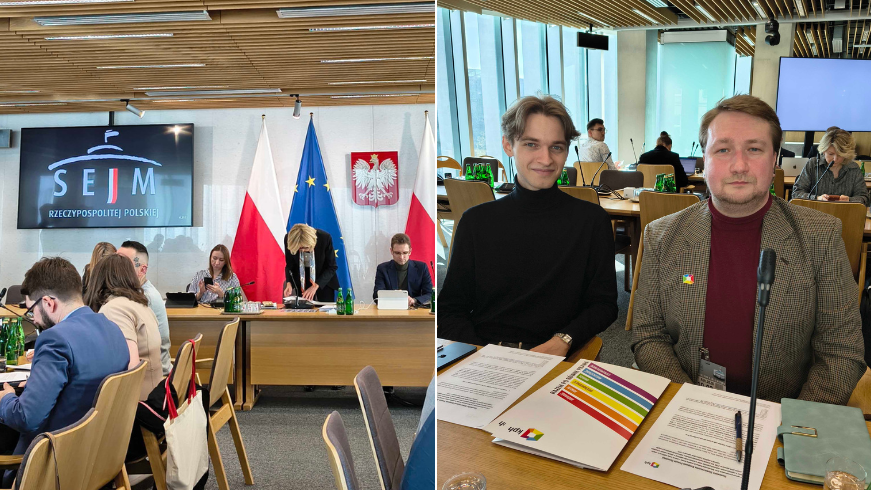
Today, March 10, a meeting of the Special Committee for the draft law on the status of the next of kin and cohabitation agreements was held. On behalf of the KPH, the meeting was attended by Mateusz Trzaska, Advocacy Coordinator, and Przemek Walas, Advocacy Manager
The Special Committee for the draft bill on the status of the next of kin and cohabitation agreements was established by the Sejm on February 13, 2026, after the first reading of the government’s bills (read more: The status of the next of kin has been referred to an extraordinary parliamentary committee. KPH: This is a good direction, but expectations are higher). This is a historic event, one that the Campaign Against Homophobia has been striving for from the very beginning. However, the association argues, this is not the end.
At every legislative stage, KPH will strive to introduce the necessary changes, especially regarding child safety. But even the passage of these bills doesn’t mean the end of the fight for us. The goal is true marriage equality, and we will continue to fight for it – emphasizes Przemek Walas.
Urszula Pasławska, MP from the Polish People’s Party (PSL), was appointed chairperson of the commission, with Katarzyna Ueberhan from the Left, Jolanta Niezgodzka from the Civic Coalition (KO), and Michał Wawer from the Confederation (Konfederacja) serving as deputies. The 18-member commission includes seven MPs from the Law and Justice party (PiS), six from the Civic Coalition (KO), and one each from the other parties (PSL, Polska 2050, Centrum, Lewica, Konfederacja).
A cohabitation agreement is a necessary minimum
During the meeting, the committee worked on government bills on the status of the next of kin (Parliamentary Paper No. 2110) and regulations implementing this bill (Parliamentary Paper No. 2111).
These are the first-ever government bills concerning same-sex relationships in Poland to be referred to a parliamentary committee. While they certainly don’t address all needs, if enacted, they will have a real impact on the daily lives of same-sex couples. Among the proposed solutions are the ability to:
- providing the other party with alimony after the termination of the contract,
- the right to use the apartment,
- authorizing the other party to medical information in the contract,
- establishing joint property,
- deciding on the burial of the other party to the contract,
- exempting the partner from inheritance and gift tax, and placing her in tax group I.
Instead of contracts, marriage equality
During the Commission meeting, representatives of the KPH (Mateusz Trzaska – Advocacy Coordinator and Przemek Walas – Advocacy Manager) pointed out significant shortcomings in the government’s proposed solutions. Firstly, the proposals allow for the conclusion of a cohabitation agreement before a notary public, rather than at the Civil Registry Office, as is the case with married couples. Therefore, the agreement will constitute an obstacle to entering into a marriage with another person, but its conclusion will not affect the individual’s marital status.
Secondly, the proposals completely exclude rainbow families, omitting the over 50,000 children raised in LGBT+ families in Poland. The drafters completely ignored their safety and failed to provide any instruments enabling even partial exercise of parental authority by the social parent.
The lack of regulations regarding children primarily means a lack of safety. Many couples raise children together, even though their documents only list one mother, for example. Yet, a social mother loves her children just as much and participates in their upbringing. Therefore, she should be able to take her child to the doctor, pick them up from preschool, or sign permission for a school trip, says Mateusz Trzaska.
Read the KPH statement (in Polish)
Today’s meeting marks only the beginning of work on the government’s bill on the status of the next of kin and the legislation that will implement it. Even if these bills gain support from the Commission, and then from the parliamentary majority, and ultimately enter into force, they will constitute only the first of many steps towards marriage equality.
Legal recognition of our unions is needed now
During the meeting, KPH representatives also pointed out the great need to introduce legal protection for same-sex relationships.
Contrary to the narrative perpetuated by the right wing that this issue concerns only the marginalized – regardless of whether the act affects a thousand or 100,000 people, the state has the duty to provide each of these people with a stable and predictable legal framework for building a safe life in Poland – adds Przemek Walas.
They emphasized that the entry into force of these laws will not create a new legal situation, but merely legitimize an existing one. This is evidenced by data from the report “The Social Situation of LGBTA Persons in Poland. Report for 2019-2020. Overview of Key Data”:
- As many as 40% of LGBT+ respondents were in same-sex relationships, and 3.7% of them had formalized their relationship abroad.
- 70% of respondents would formalize their relationship abroad if it weren’t for financial obstacles.
- The vast majority (69%) of LGBT+ people would marry their partner in Poland if possible, with this percentage increasing by as much as 20% between 2012 and 2021.
- In Poland, at least 50,000 children are raised in LGBT+ families.
Our reports tell us that at least 50,000 children in Poland are raised in same-sex families. We work with them every day, and I wouldn’t want anyone in the Polish Parliament to call them or their families “pathological”. This is simply unacceptable – adds Mateusz Trzaska.
High public support
As a reminder, support for civil partnerships remains high. A November 2025 poll conducted by the Public Opinion Research Center (CBOS) for Dziennik Gazeta Prawna shows that over 62% of respondents support the introduction of civil partnerships for same-sex couples, and half of them support marriage equality.
Especially important, this percentage is even higher among the youngest respondents – over half (52%) of those surveyed in the 18-24 age group support partnerships with the same rights as marriage, and over 26% support the introduction of partnerships for same-sex couples with limited rights.
The European Court of Human Rights has repeatedly emphasized the need for legal recognition and protection of same-sex partnerships. In its judgments against Poland, it confirmed that the lack of any regulations in this area in Poland violates the Convention.
Also check
Last added
-
20.03.2026
The Supreme Administrative Court in Poland has issued a ruling. Refusing to transcribe marriages is illegal
-
10.03.2026
The first meeting of the Extraordinary Commission on the status of the next of kin is behind us
-
05.03.2026
Summary 2025: KPH’s activities and key events. “We are not slowing down”
-
03.03.2026
Poland is once again among the infamous leaders in protecting LGBTI rights. ILGA-Europe publishes its “Annual Review 2026”
-
13.02.2026
The status of the next of kin has been referred to an extraordinary parliamentary committee. KPH: This is a good direction, but expectations are higher
KPH Newsletter
Subscribe to our newsletter and we will make sure you receive information about the actions undertaken by our organization.