
 Profile on Facebook. Page opens in new window.
 Profile on Twitter. Page opens in new window.
 Profile on Linkedin. Page opens in new window.
 Profile on Youtube. Page opens in new window.
 Profile on Instagram. Page opens in new window.
 Profile on TikTok. Page opens in new window.
 Donate KPH

The Supreme Administrative Court in Poland has issued a ruling. Refusing to transcribe marriages is illegal
In today’s ruling, the Supreme Administrative Court confirmed the interpretation of the Court of Justice of the European Union in Luxembourg, indicating Poland’s obligation to comply with EU law. Campaign Against Homofobia – “This is an extremely important step, but not the last one”
Today, March 20, the Supreme Administrative Court ruled that EU law requires Polish civil status registers to record same-sex marriages concluded abroad. Therefore, the only way to fulfill this obligation is to transcribe them, which is a requirement of every Civil Registry Office in Poland.
Today’s ruling by the Supreme Administrative Court clearly demonstrates that Poland, as a member state of the European Union, must comply with European Union law. The Supreme Administrative Court rightly upheld the interpretation of the Court in Luxembourg and indicated that the only way to implement this ruling is to allow the transcription of a foreign marriage certificate. This ruling is a significant step towards marital equality, but certainly not sufficient, commented Przemek Walas, advocacy manager at Campaign Against Homofobia.
As a reminder, the decision was issued after the Supreme Administrative Court reviewed a complaint against the judgment of the Provincial Administrative Court in Warsaw. The NSA upheld the decision of the voivode, who had previously upheld the decision of the head of the Civil Registry Office refusing to transcribe the marriage certificates of two men. The case has been ongoing since 2019 and has been heard by administrative courts of both instances and the Luxembourg Court of Justice.
In November 2025, the Court of Justice of the European Union (CJEU) answered the question of the Polish court in this case, pointing out the need for our country to recognize marriages concluded in other European Union countries. Read more: Groundbreaking CJEU ruling: Failure to transcribe a foreign same-sex marriage certificate is incompatible with EU law
Poland must comply with EU law
In its ruling today, the Supreme Administrative Court shared the CJEU’s perspective. Since the relevant treaty provisions require Poland to take into account same-sex marriages concluded abroad, the only solution is to transcribe them.
Consequently, the Supreme Administrative Court overturned both the Provincial Administrative Court’s judgment and the previous administrative decisions and referred the case to the Civil Registry Office. The Civil Registry Office should now transcribe the foreign marriage certificate, thus granting the couple’s request.
Today’s ruling sets a precedent. If the Civil Registry Office does indeed transcribe the marriage in the near future, same-sex marriage between two men will become legal under Polish law. This will open the door for many couples who have been in unrecognized marriages for years.
Recognition of a marriage concluded abroad is the first step on the road to equality, and the coming months and years will show whether the legal system will actually guarantee equal rights to all people in formal relationships, including in terms of health insurance coverage, joint taxation, tax exemptions, and inheritance.
The first meeting of the Extraordinary Commission on the status of the next of kin is behind us
Today, March 10, a meeting of the Special Committee for the draft law on the status of the next of kin and cohabitation agreements was held. On behalf of the KPH, the meeting was attended by Mateusz Trzaska, Advocacy Coordinator, and Przemek Walas, Advocacy Manager
The Special Committee for the draft bill on the status of the next of kin and cohabitation agreements was established by the Sejm on February 13, 2026, after the first reading of the government’s bills (read more: The status of the next of kin has been referred to an extraordinary parliamentary committee. KPH: This is a good direction, but expectations are higher). This is a historic event, one that the Campaign Against Homophobia has been striving for from the very beginning. However, the association argues, this is not the end.
At every legislative stage, KPH will strive to introduce the necessary changes, especially regarding child safety. But even the passage of these bills doesn’t mean the end of the fight for us. The goal is true marriage equality, and we will continue to fight for it – emphasizes Przemek Walas.
Urszula Pasławska, MP from the Polish People’s Party (PSL), was appointed chairperson of the commission, with Katarzyna Ueberhan from the Left, Jolanta Niezgodzka from the Civic Coalition (KO), and Michał Wawer from the Confederation (Konfederacja) serving as deputies. The 18-member commission includes seven MPs from the Law and Justice party (PiS), six from the Civic Coalition (KO), and one each from the other parties (PSL, Polska 2050, Centrum, Lewica, Konfederacja).
A cohabitation agreement is a necessary minimum
During the meeting, the committee worked on government bills on the status of the next of kin (Parliamentary Paper No. 2110) and regulations implementing this bill (Parliamentary Paper No. 2111).
These are the first-ever government bills concerning same-sex relationships in Poland to be referred to a parliamentary committee. While they certainly don’t address all needs, if enacted, they will have a real impact on the daily lives of same-sex couples. Among the proposed solutions are the ability to:
- providing the other party with alimony after the termination of the contract,
- the right to use the apartment,
- authorizing the other party to medical information in the contract,
- establishing joint property,
- deciding on the burial of the other party to the contract,
- exempting the partner from inheritance and gift tax, and placing her in tax group I.
Instead of contracts, marriage equality
During the Commission meeting, representatives of the KPH (Mateusz Trzaska – Advocacy Coordinator and Przemek Walas – Advocacy Manager) pointed out significant shortcomings in the government’s proposed solutions. Firstly, the proposals allow for the conclusion of a cohabitation agreement before a notary public, rather than at the Civil Registry Office, as is the case with married couples. Therefore, the agreement will constitute an obstacle to entering into a marriage with another person, but its conclusion will not affect the individual’s marital status.
Secondly, the proposals completely exclude rainbow families, omitting the over 50,000 children raised in LGBT+ families in Poland. The drafters completely ignored their safety and failed to provide any instruments enabling even partial exercise of parental authority by the social parent.
The lack of regulations regarding children primarily means a lack of safety. Many couples raise children together, even though their documents only list one mother, for example. Yet, a social mother loves her children just as much and participates in their upbringing. Therefore, she should be able to take her child to the doctor, pick them up from preschool, or sign permission for a school trip, says Mateusz Trzaska.
Read the KPH statement (in Polish)
Today’s meeting marks only the beginning of work on the government’s bill on the status of the next of kin and the legislation that will implement it. Even if these bills gain support from the Commission, and then from the parliamentary majority, and ultimately enter into force, they will constitute only the first of many steps towards marriage equality.
Legal recognition of our unions is needed now
During the meeting, KPH representatives also pointed out the great need to introduce legal protection for same-sex relationships.
Contrary to the narrative perpetuated by the right wing that this issue concerns only the marginalized – regardless of whether the act affects a thousand or 100,000 people, the state has the duty to provide each of these people with a stable and predictable legal framework for building a safe life in Poland – adds Przemek Walas.
They emphasized that the entry into force of these laws will not create a new legal situation, but merely legitimize an existing one. This is evidenced by data from the report “The Social Situation of LGBTA Persons in Poland. Report for 2019-2020. Overview of Key Data”:
- As many as 40% of LGBT+ respondents were in same-sex relationships, and 3.7% of them had formalized their relationship abroad.
- 70% of respondents would formalize their relationship abroad if it weren’t for financial obstacles.
- The vast majority (69%) of LGBT+ people would marry their partner in Poland if possible, with this percentage increasing by as much as 20% between 2012 and 2021.
- In Poland, at least 50,000 children are raised in LGBT+ families.
Our reports tell us that at least 50,000 children in Poland are raised in same-sex families. We work with them every day, and I wouldn’t want anyone in the Polish Parliament to call them or their families “pathological”. This is simply unacceptable – adds Mateusz Trzaska.
High public support
As a reminder, support for civil partnerships remains high. A November 2025 poll conducted by the Public Opinion Research Center (CBOS) for Dziennik Gazeta Prawna shows that over 62% of respondents support the introduction of civil partnerships for same-sex couples, and half of them support marriage equality.
Especially important, this percentage is even higher among the youngest respondents – over half (52%) of those surveyed in the 18-24 age group support partnerships with the same rights as marriage, and over 26% support the introduction of partnerships for same-sex couples with limited rights.
The European Court of Human Rights has repeatedly emphasized the need for legal recognition and protection of same-sex partnerships. In its judgments against Poland, it confirmed that the lack of any regulations in this area in Poland violates the Convention.
Poland is once again among the infamous leaders in protecting LGBTI rights. ILGA-Europe publishes its “Annual Review 2026”
The ILGA-Europe Annual Review 2026 report (covering events in 2025) shows that the situation for LGBTI people in Poland remains very difficult. Although there have been some minor improvements compared to previous years, Poland still ranks among the countries with the lowest level of rights protection in the European Union
What does the report say about Poland?
According to the latest ILGA-Europe report, despite the changing political climate in Poland, key legal changes that would improve the situation of LGBT+ people have yet to be implemented. Poland still does not recognize same-sex unions – neither marriages nor civil partnerships – meaning that same-sex couples lack access to fundamental family rights, such as inheritance, custody, or tax protection.
The report also highlights that protection against hate crimes based on sexual orientation and gender identity remains elusive, and in practice, LGBT+ people still face threats in public spaces and in everyday life.
Comprehensive and clear regulations regarding gender recognition have not been introduced, despite a clear call in the resolution of the Civil Chamber of the Supreme Court in March 2025. It should be noted that a year ago, the Supreme Court ruled that gender recognition trials should be conducted non-litigiously (i.e., without the need to sue one’s parents). This is one of the demands we have been pushing for years. Meanwhile, the Supreme Court clearly in its resolution obliges the legislator to comprehensively resolve the issue of gender recognition through legislation.
The report also examines the anti-discrimination protection system in individual countries. It notes that in Poland it remains incomplete and fragmented, which means that LGBT+ people often lack effective tools to defend their rights.
While the space for organizing social events, such as equality marches and NGO meetings, is more stable today than it was several years ago, these changes do not translate into real, systemic legislative reforms that would ensure the full protection of the rights and safety of members of our community.
This year’s Annual Review clearly demonstrates that certain trends occurring in Europe, including the escalation of hate speech against LGBT+ people, are also present in Poland. The section on Poland describes significant court proceedings, including those concerning hate speech against activists, as well as those concerning so-called homophobes, and the instrumental use of the institution of insulting religious feelings by placing a rainbow flag on a statue of Christ. It also mentions the amendment to the Penal Code regarding crimes motivated by prejudice, which ultimately did not enter into force, and the judgments of the European Court of Human Rights against Poland. This report can be a source of inspiration for discussions about the limits of permissible freedom of expression and comparisons across countries – comments Annamaria Linczowska, Advocacy and Litigation Coordinator, who consulted on the report on behalf of the KPH.
Systemic attack on the community
As the report shows, restrictive practices against LGBT+ people have become established in Europe and Central Asia in 2025, including:
- criminal laws against “propaganda”,
- control of foreign funds,
- restrictions on gatherings,
- definitions of gender in biological terms.
Hungary and Turkey banned marches, and Russia continued its crackdown on organizations deemed extremist. New laws in Belarus and Kyrgyzstan criminalized the promotion of LGBT+ issues to children, and administrative sanctions and digital monitoring restricted the organizations’ activities. Activists and journalists were arrested or prosecuted in numerous countries, including Turkey and Hungary.
Schools and universities became places where content related to gender orientation and identity was restricted or even eliminated. Hungary, Slovakia, and Georgia introduced constitutional or legislative changes restricting the recognition of transgender, intersex, and non-binary people. Nevertheless, some countries strengthened their rights:
- In Poland, “LGBT-free zones” were abolished (see more: “LGBT-Free Zones” In Poland Became History!),
- Spain maintained anti-discrimination laws,
- Denmark and the Council of Europe promoted the rights of intersex people.
The specter of prejudice-driven disinformation and the influence of far-right and populist groups on the law hangs over Europe. In Central and Eastern Europe, more and more countries are embarking on a path of systemic discrimination against LGBT+ people under the guise of protecting families, traditional values, and freedom of speech. This last aspect, in particular, is increasingly being used as a counterargument in discussions about regulating social media and forcing platforms to implement more effective methods for removing and limiting hate speech – comments Przemek Walas, Advocacy Manager,
and adds
It’s hard not to connect this with the current administration of Donald Trump and the MAGA movement, which has targeted the LGBT+ community. The influence of ultra-conservative organizations is already visible in Bulgaria, Romania, Lithuania, and Slovakia. The American administration is also trying to influence the decisions of the European Commission and the European Parliament. This is a very dangerous trend and, at the same time, one of the key challenges facing the European Union: how to effectively defend democratic values and human rights in the age of artificial intelligence and deepfakes.
The Annual Review report is being developed with the participation of activists from 54 countries. The chapter on Poland is being consulted by the Campaign Against Homophobia and the Trans-Fuzja Foundation.
Read the summary about Poland
Read the full report
The status of the next of kin has been referred to an extraordinary parliamentary committee. KPH: This is a good direction, but expectations are higher
On Friday, February 13th, MPs decided to refer the bill for further consideration to a special parliamentary committee, appointed at the request of the Polish People’s Party (PSL). This is the first government bill recognizing the existence of same-sex relationships to gain the support of a parliamentary majority
The bill submitted to the vote replaced the government’s earlier proposal for a law on civil partnerships. KPH, along with other organizations, repeatedly pointed out that the first proposal provided very little security for partners in same-sex relationships. Particularly disturbingly, the government completely ignored the issue of the approximately 50,000 children raised by same-sex couples. This specifically concerns the continued care of the social parent for children in the event of the death of their biological parent.
Unfortunately, the bill just passed in its first reading is even more limited – submitting declarations at the Civil Registry Office has replaced the signing of a notarial deed, and there is no statutory inheritance. The bill only addresses basic security issues, such as exemption from inheritance and gift tax, the existence of optional joint property partnerships, joint taxation, and health insurance coverage.
We already said with the government’s draft bill on civil partnerships that it was a bare minimum. The proposal approved today is even less – the dignity and safety of rainbow families have once again become a political game, and civil society has been completely excluded from the work on this bill. That’s why we will be pushing for changes to this bill in parliamentary committees” – says Przemek Walas, Advocacy Manager in KPH.
This law doesn’t fully address the needs of LGBT+ people in relationships. However, it does offer the basic security that many couples in Poland need every day.
It is good that the government continues to work in this area, and today’s vote is another milestone on the way to legal recognition of same-sex unions, adds Przemek Walas.
In the coming weeks, the draft law on the status of the closest person in a relationship and on cohabitation agreements will be further reviewed by a special committee appointed for this purpose. KPH will participate in the committee’s work to ensure the legislative process moves as quickly as possible and to ensure that any amendments submitted during the process deliver the best possible results for all informal relationships, regardless of the partners’ gender.
Another edition of Pride & Parent workshops is behind us, online workshops coming soon!
On 29–30 November, another Pride & Parent workshop took place in Wrocław – a unique event dedicated to queer women, mothers, and people with experiences of womanhood who are considering or already pursuing parenthood.
During two days of sessions, participants had the opportunity to gain practical knowledge about the legal and medical aspects of LGBT+ parenting, as well as to discuss emotions, relationships, and lived experiences related to parenthood.
What consistently proves to be the most valuable element of each meeting is mutual support, openness, and understanding. These qualities transform the workshops from a purely educational format into a space of community building, trust, and safety.
We extend our gratitude to all participants for their trust, openness, and willingness to share their stories. Each edition reaffirms how deeply needed initiatives like this are.
What’s next?
In response to the great interest and messages from people across the country, the next edition of Pride & Parent will take place online. This format will allow participation for those who cannot attend in-person meetings.
The online workshops will be shorter, yet equally focused, informative, and engaging. The expert program will cover key medical and legal aspects of LGBT+ parenthood, and has been developed by a therapist, lawyer, and midwife.
More information soon!
To make it possible for us to meet people in person across different cities in Poland next year, we need support. Support our initiative and help us reach those who need safe and supportive spaces the most.
Support “Pride & Parent” workshops
No changes here. Two years of Donald Tusk’s rule.
On October 15, 2023, driven by hope for change, we decided in record-breaking elections that power would go to a coalition of pro-democratic parties. We were given very specific promises: combating hate speech, civil partnerships, overhauling the judicial system, and liberalizing abortion law. Among the urgent issues to be addressed by decision-makers is a dignity-based gender recognition procedure. After two years in power, we can confidently say: no changes for us. Let’s take a look at what has happened over the past two years on key issues for the LGBT+ community.
Civil partnerships
In the case of civil partnerships, after nearly two years of discussions, negotiations, record-breaking public consultations, and widespread public support, the government failed to adopt the bill, the Sejm is not working on it, and in recent weeks we have a bill-proposal that provides even less protection for partnerships than the government’s already compromised bill.
According to the latest poll conducted by Opinia24, 54% of respondents support the introduction of civil partnerships in Poland.
Protection against hate speech and hate crimes
This is the only proposal included in the coalition agreement. The initial stages of work on amending the Penal Code were very promising. The amendment proposed expanding code protection based on age, gender, disability, sexual orientation, and gender identity. During the process, gender identity was deleted and protection was limited solely to individuals who actually possessed a given characteristic. However, thanks to the hard work of social organizations, a successful draft was developed, which was voted on by the Sejm and Senate. Andrzej Duda referred the draft to the Constitutional Tribunal, which ruled the amendment unconstitutional. In short, nothing has changed regarding protection against hate speech against LGBT+ people.
Gender recognition
Although this demand did not appear explicitly in their election platforms, organizations have been raising the need for years to change the way gender recognition is handled in Poland. The then-Minister of Justice, Adam Bodnar, issued a regulation that gave gender recognition cases a high priority. Furthermore, the practice introduced by Zbigniew Ziobro of requiring the mandatory participation of prosecutors in gender recognition cases was ended.
The Supreme Court’s ruling reversed nearly 30 years of established case law and relegated gender recognition cases to non-litigious proceedings. At the same time, it obligated the legislature to introduce a comprehensive statutory solution. All indications are that the government and parliament will not address this issue during this term.
Has anything changed for the better?
The narrative towards LGBT+ people has certainly changed. This is evident in the example of public media, which has moved away from language of contempt and hatred towards our community. Adam Bodnar’s apology, as Minister of Justice, was symbolic. He apologized to LGBT+ people for years of systemic violence and discrimination by the state. We are also seeing a shift in politicians’ approach to equality issues.
A noticeable change is the emergence of partners on the other side with whom we can talk.
It’s a shame that this is still a layer of declarations, not real change.
2025 Crowns of Equality – become a Partner
The Crowns of Equality are one of the most important and prestigious awards that can be received in Poland for activities for the LGBT+ community. This year’s awards will be given in 8 categories, and the winners will be announced during a formal gala on September 25 in Warsaw. Create this event with us – become a Partner of this year’s Crowns of Equality.
Awards categories
The awards are given in eight categories: Activism, Institutions, Politics, Law, Media, Internet, Culture, Business. People participating in an online vote decide who will receive the statuettes. Meet the people and groups who have received awards so far.
More than Gala
After the Gala, there is a banquet for invited guests – it’s a great opportunity to meet and talk to many people from LGBT+ community, allies, and activist people. The Gala is also honoured by a private concert.
What are the advantages of cooperation during the Crowns of Equality?
- Support for one of the most important and prestigious LGBT+ community events in Poland,
- the presence of people from the world of politics, media, show business, diplomacy, business,
- hundreds of people in the audience and thousands watching the live broadcast,
- presence in national media,
- great fun and a unique gala atmosphere.


After 20 years, Mirka Makuchowska says goodbye to KPH
At the end of the year, Mirosława Makuchowska is leaving the Campaign Against Homophobia – director, long-time member and co-founder of our organization. This is a symbolic moment – one of the most important eras in the history of KPH is ending. It is hard to imagine our organization without Mirka, but it is thanks to her that we are where we are.
Mirka began her journey in 2005 as a local activist in Wrocław. She quickly became a leader who not only inspired others, but also built structures supporting LGBT+ people throughout Poland. As a coordinator of a local branch, and then responsible for the development of local communities, she created a network of 12 KPH branches in various cities, reaching out with help and support where it had previously been lacking.
In the following years, she took on the role of advocacy manager, and in recent years, director of the entire organization. She has always had one goal – to improve the lives of LGBT+ people in Poland. She was the voice of the community in the media, the Sejm, but also on the European and global forums. Throughout this time, she did not lose touch with the movement – she remained a part of it, listening, reacting, supporting.
At the end of the year, I am leaving KPH, but my faith in this organization and its mission remains deep and unwavering. For 20 years, I have had the honor of being part of this journey – from grassroots activities to responsibility for the entire organization. KPH is a unique place created by extraordinary people who work every day with passion and determination for equality for the LGBT+ community. I thank everyone with whom I had the privilege of working – for strength, solidarity and shared dreams. I believe that KPH will continue to boldly bring change. Hope is in people – and KPH is its best example – says Mirka Makuchowska.
Mirka was and is not only a leader, but also a mentor, trainer and inspiration for hundreds of activists. She trained thousands of people in schools, companies and institutions, prepared educational programs, campaigns and research. She fought for a safe life for all of us.
Mirka is a leader who has always listened to the community. Thanks to her, the voice of LGBT+ people was heard and KPH was strong and independent. She introduced changes that were fundamental to our strength as an organization, but also to the entire movement – says Miko Czerwiński, co-chair of the KPH board.
Mirka – first a girl warrior, then a woman leader – trod the path of Polish activism at a time when there were no structures, textbooks or authorities to refer to. For me, she is my personal heroine, one of the first girls fighting for the rights of LGBT+ people. Stubborn, seeing more than others, with a plan for the future, certain of her reasons. Sometimes tired, frustrated and wanting to escape. An inspiration to rest and then return to the fight. We will miss you very much, but what you leave is a solid foundation on which KPH will grow – adds Urszula Jakubowska, treasurer of the KPH board.
Mirka is a true leader – committed, down-to-earth, clearly defining the direction of action. At the same time, she is an extremely empathetic, supportive person, always open to discussion and a different point of view. Mirka is a person who gives space to act and fulfill professionally – says Monika Weryszko, PR and Communication Manager. For me personally, Mirka is also a model of how to efficiently manage an organization and a team despite various turbulences, without losing sobriety and the set goal – she adds.
Mirka – thank you for your enormous work, for all the campaigns, speeches, articles and trainings. For your commitment, persistence and belief that Poland can be a country of equal rights. For building KPH throughout all these years not only as an institution, but above all as a community. Your achievements remain with us.
KPH Management Board and Team
Amendment to the Criminal Code on Hate Crimes and Hate Speech Is About Ensuring Everyone’s Safety – NGOs Claim
Polish law still does not provide effective protection against hate crimes and hate speech — anyone can become a victim, and the lack of appropriate regulations amounts to tacit approval of violence and discrimination. After years of tolerating homophobia and transphobia, supported by the previous government and public media, amending the Criminal Code is necessary to ensure the safety of LGBT+ individuals and restore basic legal standards in Poland. On December 19, during a press conference in the Sejm, a joint statement on this matter was presented by 37 civil society organizations — acting as the Coalition for Equal Opportunities and supporting organizations.
Where Are We in the Legislative Process?
Work on amending the Criminal Code regarding hate crimes and hate speech began in March of this year, with the publication of the first government draft. This proposal aimed to extend provisions to include five additional grounds: gender, disability, age, sexual orientation, and gender identity. The Campaign Against Homophobia (KPH), along with many other civil society organizations, submitted comments that were not incorporated (read – in Polish: KPH składa uwagi do projektu nowelizacji Kodeksu karnego w zakresie ochrony przed przestępstwami z nienawiści i mową nienawiści – Kampania Przeciw Homofobii | Kampania Przeciw Homofobii. However, the project did not make it to the Sejm and was sent back to the government stage.
In October, a new version of the draft was published, but it omitted gender identity, despite its critical importance. Civil society organizations once again submitted their feedback, but these were also ignored (read in Polish: Brak tożsamości płciowej w październikowym projekcie nowelizacji Kodeksu karnego – KPH składa uwagi – Kampania Przeciw Homofobii | Kampania Przeciw Homofobii and Nowelizacja Kodeksu Karnego: uwagi KPH znowu nie zostały uwzględnione w projekcie – Kampania Przeciw Homofobii | Kampania Przeciw Homofobii). At the end of November, the draft was approved by the Council of Ministers and submitted to the Sejm.
The first reading of the bill took place on December 19, the same day as a press conference during which 37 civil society organizations presented a joint statement on the necessity of amending the Criminal Code. The conference was attended by representatives of the Polish Society of Anti-Discrimination Law, Amnesty International, and KPH.
NGOs Call for a Full Definition of Hate Crime and the Inclusion of Gender Identity
The Campaign Against Homophobia (KPH) initiated the joint statement of the Coalition for Equal Opportunities on the amendment to the Criminal Code. The main issues highlighted include the lack of a definition of hate crimes and the omission of gender identity as a protected ground in the Criminal Code. Adding gender identity as a protected category is essential to provide comprehensive protection for individuals experiencing violence motivated by transphobia. Currently, there are doubts whether the proposed phrase “in connection with gender” covers such offenses. Explicitly specifying this ground is recommended by the European Commission against Racism and Intolerance (ECRI) and the Polish Commissioner for Human Rights.
For over 20 years, Polish law has protected minorities from hate-based attacks. However, this protection is selective. This amendment aims to equalize this protection and include all groups vulnerable to hate-based violence. Excluding transgender people from this list is simply cruel, as this group, among LGBT+ individuals, is the most frequently attacked (nearly one in five trans people has experienced physical violence) — just for being themselves, said Mirosława Makuchowska, Director of KPH.
The absence of a definition of hate crime is another significant flaw in the draft. Organizations propose that the definition in Polish law should be based on ECRI recommendations. This would allow for more effective protection of victims and recognition of a broader range of actions as hate-motivated crimes, while maintaining precision in defining such acts.
During public consultations, civil society organizations emphasized the need for including a legal definition of hate crime in the Criminal Code. These voices should not be ignored. Experiences of marginalized groups show that bias-motivated crimes are not limited to the specific acts listed in the substantive part of the code. Introducing a legal definition would expand criminal law protection for other acts motivated by hatred and address challenges in determining the actual scale of such crimes, commented Anna Matras, Legal Analyst at Amnesty International.
Systemic problem requires systemic solutions. Recent years have shown that hate crimes are a systemic issue. Experiences from other marginalized groups confirm the need for a comprehensive solution that examines the discriminatory nature of crimes. Additionally, the government must implement extensive training for law enforcement, courts, and prosecutors, and issue appropriate recommendations in this area, as we often hear reports of victims of hate-motivated attacks being ignored by institutions, said Miko Czerwiński of the Równość.org Foundation, one of the organizations endorsing the statement.
The authors of the statement emphasize that amending the Criminal Code is not merely a demand of organizations advocating for LGBT+ rights but a broader initiative also supported by human rights organizations with expert knowledge and experience in combating discrimination (including those within the Coalition for Equal Opportunities). The proposed changes result from consultations with lawyers and legal experts who deal with such cases daily.
Read the full text of the statement (in Polish)
Crowns of Equality – vote!
The Crowns of Equality (Korony Równości) are considered the most important awards granted in Poland for advocacy for the LGBT+ community. Vote in this year’s plebiscite by September 6th on www.koronyrownosci.pl (only in Polish).
The jury nominated individuals and groups who have a chance to receive this year’s Crown of Equality in one of several categories of the plebiscite:
☑️ Activism: Tęczowe Rodziny Foundation, Kazik Strzelec, Anna Matras,
☑️ Institutions: Marshal’s Office of the Lublin Voivodeship in Lublin, dr Kosma Kołodziej, Aleksander Miszalski,
☑️ Law: Anna Mazurczak, Marcin Pawelec-Jakowiecki, Koalicja na rzecz związków partnerskich i równości małżeńskiej,
☑️ Media: Tomasz-Marcin Wrona, Anna Gmiterek-Zabłocka, Podcast Inna Polska,
☑️ Internet: Stonewall Group, Mamo Patrz, Orientuj.się,
☑️ Culture: Voces Gaudii, Renata Lis, 15. LGBT+ Film Festival
☑️ Business: Perspektywy Women in Tech, Sephora Polska, Converse.
More information: www.koronyrownosci.pl
???? Each person who votes, will receive a gift from OUTfilm (queer streaming platform, Media Partner of the Crowns of Equality 2024): access to the platform for PLN 1 for the first month!
???? On September 12, we will find out who the winners are – watch the live broadcast of the awards ceremony on Facebook or YouTube of the Campaign Against Homophobia.

PSL deputies ignore rainbow families’ invitation to talks
The fate of the government’s bill on civil partnerships is hanging in the balance – but we have no doubt that internal adoption is an integral part of it. On Wednesday, June 26, a press conference on civil partnerships and internal adoption of children was held in the Sejm of the Republic of Poland. The floor was taken by people who need these changes and are affected by them – rainbow families. The day before, the families asked the PSL deputies for a meeting – unfortunately, it did not take place in the end.
Paulina and Patrycja with Vincent, Nadzieja and Dominika (@matki_polki_teczowe), Aleksandra and Karolina with Olek (@mamo_patrz), Anna as well as Michalina and Remigia talked about why they need civil partnerships, indicated what they are afraid of not being able to formalize their relationship and knowing that the Polish state does not protect their children.
See the conference recording (in Polish)
Why do rainbow families need a civil partnership law?
There are tens of thousands of families like those in the Sejm of the Republic of Poland. All families and all children need guaranteed safety. Rainbow families want, among other things:
- secure the child’s situation in case of the death of the biological mother, who is listed in the documents – currently, the social mother is a stranger to the children and in case of the death of the biological mother, the children may be cared for by other people (e.g. grandparents), and not the social mother they know and are raised with,
- regulate issues related to decision-making in everyday matters, such as a visit to the doctor or picking up from school – currently, a social mother must have a number of authorisations,
- travel freely with the child – so that the child can travel under the care of each mother, without the need for the social mother to present a series of authorisations,
- regulate issues related to inheritance by a partner under the law and the use of tax exemption,
- regulate the issue of exemption from tax on gifts between close persons,
- decide about the funeral of partner,
- have the option of taking your partner’s surname or a joint surname,
- be treated by the Polish state as family.
Civil partnerships are not a “fiction” of activists and non-governmental organizations. The lack of civil partnerships affects real families – behind this lack, there are stories that have faces and we showed these faces during the press conference in the Sejm.
PSL deputies ignore rainbow families’ invitation to talks
Before the press conference, the rainbow families invited the PSL deputies to a meeting to talk to them like a parent to a parent. Unfortunately, their request was ignored, and the only person from PSL they managed to talk to for a while was Marek Sawicki – unfortunately, this “meeting” was not the most pleasant.
See how the “meeting” with Marek Sawicki went (in Polish)
Crowns of Equality – become a Partner
The Crowns of Equality are considered the most important awards granted in Poland for advocacy for the LGBT+ community. The poll has been organised by KPH since 2019 in order to honour individuals and groups who have been particularly involved in the fight for equal rights for the LGBT+ community in a given year. KPH announces the winners during a formal gala of the Crown of Equality poll which which will take place on September 12 in Warsaw. Create this event with us – become a Partner of this year’s Crowns of Equality.
Awards categories
The awards are given in eight categories: Social Engagement, Equal Treatment, Political Life, Law, Media, Internet People, Cultural World, and Business. People participating in an online vote decide who will receive the statuettes. Meet the people and groups who have received awards so far.
More than Gala
After the Gala, there is a banquet for invited guests – it’s a great opportunity to meet and talk to many people from LGBT+ community, allies, and activist people. The Gala is also honoured by a private concert.
What are the advantages of cooperation during the Crowns of Equality?
- Support for one of the most important and prestigious LGBT+ community events in Poland,
- the presence of people from the world of politics, media, show business, diplomacy, business,
- hundreds of people in the audience and thousands watching the live broadcast,
- presence in national media,
- great fun and a unique gala atmosphere.
The Strasbourg Court has ordered Poland to recognize the rights of same-sex couples. The denial of civil unions and marriage equality is discrimination. “Mr. Prime Minister, let’s meet,” say LGBT+ organizations and lawyers.
The Strasbourg Court has ordered Poland to recognize the rights of same-sex couples. The denial of civil unions and marriage equality is discrimination. “Mr. Prime Minister, let’s meet,” say LGBT+ organizations and lawyers. Today (December 12, 2023) the European Court of Human Rights (ECtHR) ruled in a case against Poland brought by five Polish same-sex couples seeking legal recognition of their relationships. The ruling states that Poland has violated the Convention and has an obligation to introduce legal protection for same-sex couples. The form of this protection shall be appropriate and shall protect same-sex couples effectively.
The verdict comes after eight years of work by the Coalition for Civil Unions and Marriage Equality, founded by the Love Does Not Exclude Association, the Campaign Against Homophobia, pro bono law firms, attorneys, the Polish Society for Anti-Discrimination Law, and the Helsinki Foundation for Human Rights. But most importantly, it marks the end of a court battle by five gay and lesbian couples who are demanding equal treatment from Poland.
“This ruling is proof that the defiance of individuals can change reality. Our Coalition is a testament to the fact that when politicians fail, ordinary people take matters into their own hands and successfully fight for their rights. The tenacious persistence of these five couples has shaken the state. As of today, we start living in a new reality in which the roles have reversed. Same-sex couples no longer have to ask to be recognized in court or in an office. Thanks to the Court’s verdict, it is the state that has to start justifying why it has not yet put proper legal protection in place,” says attorney Paweł Knut, coordinator for the Coalition.
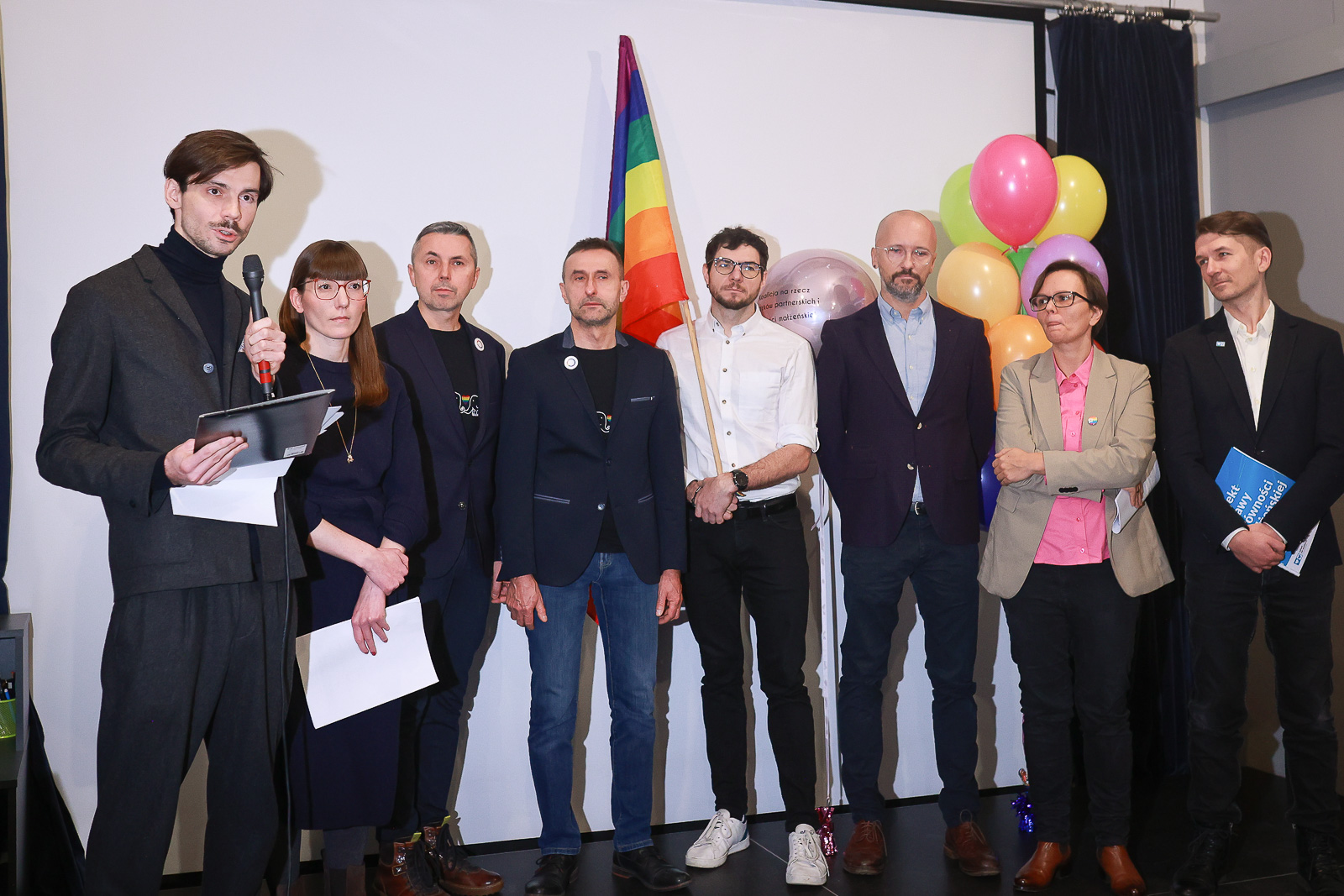
Press conference, photo: Tomek Kaczor
How did the couples react to the verdict?
“After years of right-wing rule and no progress in our case, this news has made us very happy. We became hopeful that we may live to see the moment when the state finally acknowledges our 20-year relationship after all. This is important to us for practical reasons – security in our daily lives – but also for symbolic reasons: so we can finally feel that the state treats us on an equal footing with other citizens. Of course, we hope that the ruling coalition will take the verdict seriously and quickly fulfill the promises they made during the election campaign,” commented Michał and Wojciech, one of the litigant couples.
“Finally! We are very happy about this verdict. We hope that it will set in motion a whole avalanche of good changes in Poland in terms of the rights of all non-heteronormative people, and that finally our state and the new authorities will take us seriously. We have been waiting for this day for a very long time. The years of the Law and Justice (PiS) government were especially harsh – an excruciatingly long time of constant viciousness against us and of spreading hate speech with impunity. We hope that genuinely good changes are coming and that we will soon be able to feel dignified and safe in our homeland. We want to finally formalize our 21-year relationship in the same way as different-sex couples do. There is no justice without equality,” say Krzysztof and Grzegorz, the second of the couples subject to the ECtHR ruling.
What did the Court rule?
The judgment said that by denying same-sex couples legal recognition of their unions, Poland is violating their right to respect for family life. The Court called on Poland to redress this damage by introducing appropriate legislative changes as soon as possible, without specifying what exact form they should take.
“This judgment leaves no doubt: the lack of legal recognition of same-sex couples in Poland contravenes the European Convention on Human Rights and the right to respect for private and family life that it guarantees. The Strasbourg Court’s ruling is unequivocal and stable, as has already been seen in judgments handed down in similar cases involving other European countries. I can only envision a positive outcome: the Polish authorities are obliged to effectively implement this judgment by changing Polish law. Together, we hope that this will happen as soon as possible,” says attorney Małgorzata Mączka-Pacholak, one of the lawyers representing the couples in Strasbourg.
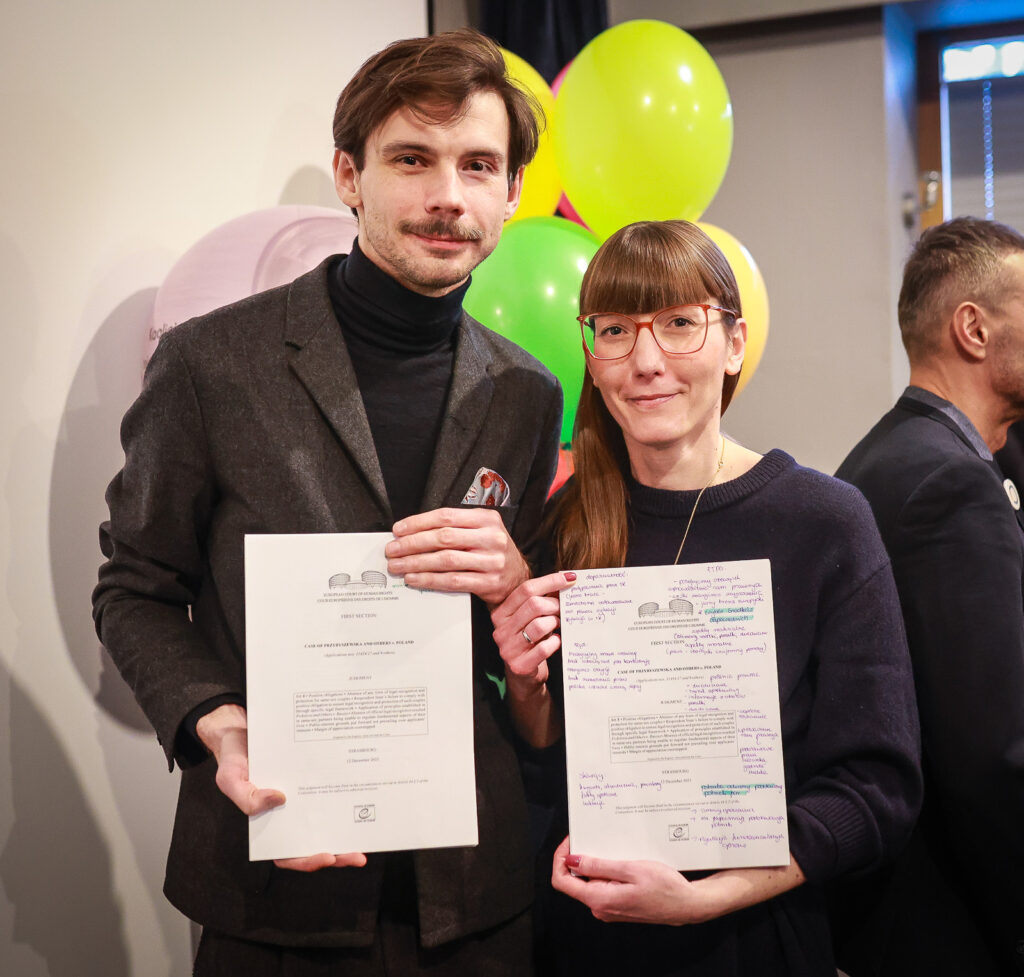
Press conference, photo: Tomek Kaczor
What will the Polish authorities do?
The Court has already ruled in similar cases brought against Italy (in 2015), Russia, Romania, and Bulgaria (this year), and found that the plaintiff couples were right to demand legal safeguards from their countries. Shortly after the ruling, Italy introduced civil unions that grant same-sex couples some of the rights available to married couples. What do NGOs expect from the Polish authorities?
“Public support for marriage equality is growing and approaching 50%. Support for civil unions has been above this threshold for years. A draft bill on marriage equality has also been prepared. Today, the Court made it clear that safeguarding the rights of same-sex couples in Poland is not a matter of discretion, but the duty of politicians. We are ready and willing to work, we are just waiting for a signal to the new government,” says Hubert Sobecki of the Love Does Not Exclude Association.
“After 8 years of humiliation, a campaign of hatred against LGBT+ people by the government and the state apparatus, a face-to-face meeting with the Prime Minister is badly needed, not least so that Polish women and men can see that there is no longer a better and worse class of citizens, only one nation that we, LGBT+ people, are a part of,” says Mirka Makuchowska of the Campaign Against Homophobia.
“That’s why we are jointly calling on Prime Minister Tusk today to meet with LGBT+ organizations to talk about the next steps: changing the law to one that will protect all and any of us,” Makuchowska and Sobecki add.
“It is certainly Poland’s duty now to carry out the judgment by introducing civil unions. I have no doubt that the new government is finally committed to fulfilling its obligations as a member of the Council of Europe,” says Anna Mazurczak of the Polish Society of Antidiscrimination Law.
“We are glad that finally, more than 10 years after the first legal complaint about the lack of legal protection for same-sex unions in Poland was filed with the support of the Helsinki Foundation, the Court has issued a verdict on rainbow families. Now it will be the government’s job to carry out this judgment, change the law and allow same-sex couples to formalize their relationships,” says Jarosław Jagura, a lawyer working with the Helsinki Foundation for Human Rights.
Poland at the tail end of Europe
The European Court of Human Rights rules on cases involving the 46 member states of the Council of Europe, from Iceland to Turkey. There is a divide among them when it comes to the rights of same-sex couples, with countries in Western Europe offering greater legal protection and countries east of the former Iron Curtain ignoring or violating the rights of LGBT+ people.
The divide is even deeper when one looks just at the European Union, where only five countries do not allow same-sex couples to formalize their relationships. Besides Poland, these are Bulgaria, Lithuania, Romania, and Slovakia.
Within the EU, marriage equality has been introduced by Austria, Belgium, Denmark, Estonia, Finland, France, Germany, Ireland, Luxembourg, Malta, the Netherlands, Portugal, Slovenia, Spain, and Sweden. Married same-sex and different-sex couples in those countries have the same rights and obligations. In turn, Czechia, Croatia, Cyprus, Greece, Latvia, Hungary, and Italy have introduced civil unions. Each of these countries offers a different set of rights, but one that is always more limited than marriage.
Attempts to grant rights to same-sex couples have been underway in Poland for more than 20 years. Several widely different draft bills on civil unions and one on marriage equality have been submitted to the Polish parliament, the Sejm, which has either rejected or not proceeded with them at all. In 2022, the Supreme Administrative Court ruled that the Constitution does not prohibit the introduction of civil unions or marriage equality.
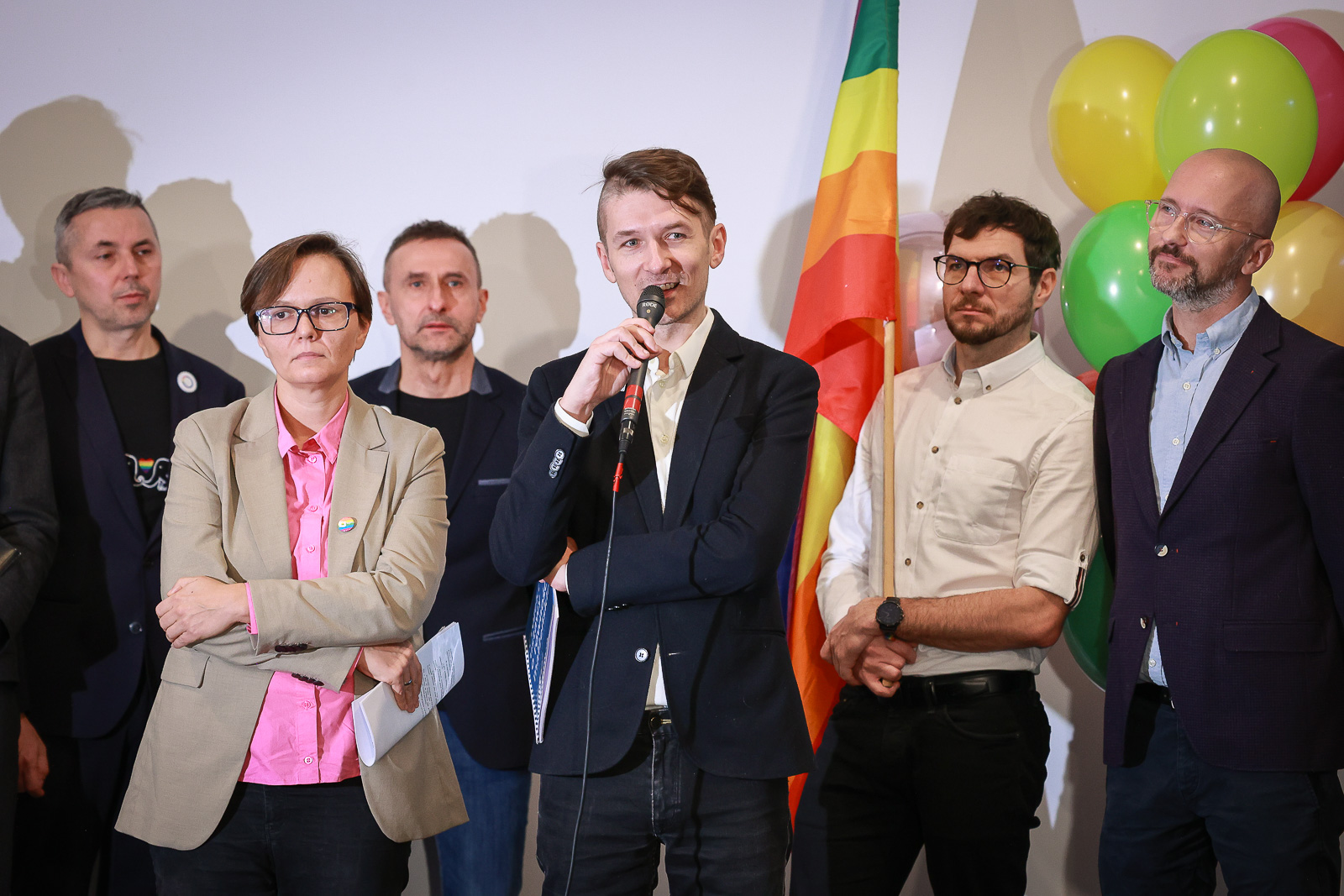
Press conference, photo: Tomek Kaczor
Media contact:
- Małgorzata Mączka-Pacholak, attorney, one of the attorneys representing the couples before the ECtHR, + 48 603 345 650
- Hubert Sobecki, Love Does Not Exclude, +48 501 647 563, hsobecki@mnw.org.pl
- Anna Wrzeszczyńska, Campaign Against Homophobia, 505 023 311, awrzeszczynska@kph.org.pl
For more information, visit www.dostrasburga.pl
The Coalition for Civil Unions and Marriage Equality was established in November 2015. It is made up of five gay and lesbian couples and the NGOs supporting them – Love Does Not Exclude, the Campaign Against Homophobia, the Polish Society for Anti-Discrimination Law, and the Helsinki Foundation for Human Rights – legal counsel Marcin Górski and attorneys Paweł Knut and Krystian Legierski, as well as attorneys Małgorzata Mączka-Pacholak, Paweł Osik, and Mikołaj Pietrzak of the law firm Pietrzak, Sidor and Partners, as part of the Polish Society for Anti-Discrimination Law’s “Pro Bono for Equality” program. The Coalition’s goal has been to lead to the European Court of Human Rights’ historic ruling that will oblige Poland to adopt legislation allowing same-sex couples to enter into civil partnerships or marriages.
Q&A
- What does the judgment say?
The ECtHR ruled that there was a violation of the right to respect for private and family life and of the prohibition of discrimination against same-sex couples on the grounds that they cannot formalize their relationship in any way.
- Is this judgment binding on Poland?
The verdict is binding on Poland and the Polish authorities are obliged to implement it.
- Can the Polish authorities ignore this verdict? What are the consequences for doing so?
The Polish authorities can ignore the ECtHR judgment, as shown by the example of the judgements on rule of law. They may even use the Constitutional Court to challenge the binding force of the ECtHR judgment. However, the Polish authorities should not disregard the ECtHR ruling, because the obligation to comply with it stems from Article 46 of the European Convention on Human Rights. If the Polish authorities do not comply with the judgment, we will face supervision/enhanced supervision by the Committee of Ministers of the Council of Europe and admonitions in the international arena, which will weaken Poland’s image. Unlike the EU system, the Council of Europe bodies cannot impose financial penalties on States Parties to the Convention for failure to implement a judgment.
- Will someone monitor the implementation of this judgment?
Yes, a special body of the Council of Europe, the Committee of Ministers of the Council of Europe (CME). If there are delays with the implementation of the judgment, the CME will call on the Polish authorities (in practice, on the Ministry of Foreign Affairs) to provide information and an explanation as to what the plan is for the implementation of the judgment.
- Can this judgment be appealed?
Yes, a party that is dissatisfied with a judgment has 3 months from its issuance to file a referral to the Grand Chamber of the ECtHR. In practice, the parties (the Polish government) very rarely use this route, and even more rarely do so successfully. To submit a request for a case to be heard by the Grand Chamber, it must be demonstrated that serious and exigent conditions have been met, such as a serious issue with respect to the interpretation or application of the Convention or its Protocols or a significant issue of general importance. With regard to this particular victory, since the ECtHR’s case law is so stable, the Polish government’s application is unlikely to succeed.
- Does the implementation of this judgment require an amendment to the Polish Constitution?
In our opinion, as far as single-sex unions are concerned, the implementation of the ECtHR judgment does not require an amendment to the Polish Constitution. Our position is that Article 18 of the Constitution provides special legal protection for marriages as a union of a man and a woman, which means that 1) the Constitution does not define what marriage is (it only provides special protection for different-sex marriage AS a union of a man and a woman, not marriage, THAT IS, a union of a man and a woman) and 2) it is possible to grant other (e.g., statutory) legal protection to civil unions, including those of same-sex couples, though less comprehensive than for marriages.
- Does this ruling mean that civil unions should be introduced for heterosexual couples?
The ECtHR’s judgment concerns complaints filed by people in same-sex unions as well as objections to the inability to formalize and legally protect such relationships. Of course, there is no obstacle for future legal changes to also amend the legal situation of people in different-sex unions.
We have a chance for a democratic government
Will the election results change the lives of LGBT+ people for the better?
The State Election Commission has announced the official election results – we know the composition of the Sejm and Senate for the next term. There is a chance to form a democratic coalition government that can bring the necessary changes and bring us closer to a Poland of equal rights and safety for LGBT+ people. Without this, we cannot speak of democracy. The democratic opposition so far, i.e. the Civic Coalition, the New Left and the Third Way won 248 seats (i.e. a parliamentary majority) in the Sejm, and the candidates and candidates from the so-called Senate Pact won 66 seats in the Senate (out of 100).
The Polish women and men elected not only to remove Pis from power, but a concrete vision of a Poland with a European and democratic. Poland in which women and LGBT+ people can feel safe and live in harmony with each other. We hope that the coalition’s promise is not just about winning over PiS, but about building a concrete vision of Poland based on paragraphs and legislation, the way laws are changed in democratic countries.
What changes do we think should be made first?
- laws on civil partnerships and marriage equality,
- amendment to the Penal Code: protection against hate speech and hate crimes,
- implementation of EU Equality Directive: protection against discrimination, e.g. in services, social security, health care,
- revision of the school curriculum in terms of equal treatment and antidiscrimination,
- Gender Reconciliation Act, based on the principle of self-determination.
There is no democracy without LGBT+ equality – the government will hear this from us more than once.
We will be talking to politicians, negotiating and making sure LGBT+ rights are not missing from the coalition agreement.
@donaldtusk are you talking to Democratic party leaders about civil partnerships in the coalition agreement? Enough of just looking at the hands of politicians, we’re hoping for conversations, meetings, negotiations, the way politics is done in democratic states under the rule of law!